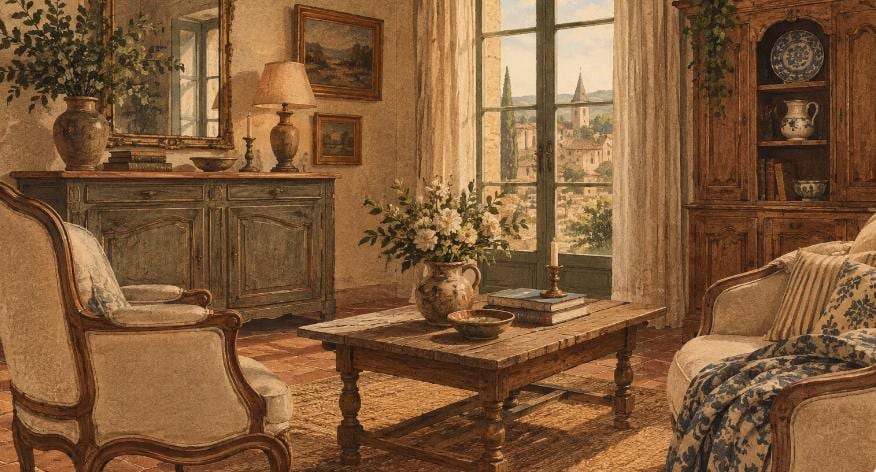
A weathered oak buffet can do more for a dining room than an entire matching set. French country furniture earns its place through that kind of presence: carved, practical, softly aged, and never overly precious. It gives a room visual history without requiring a literal recreation of a farmhouse in Provence. For collectors, homeowners, and designers, the appeal is in the balance. These pieces can be graceful without becoming formal, rustic without looking rough, and decorative without losing their usefulness. A well-chosen antique or vintage French country piece introduces texture, depth, and a sense that the room has been assembled over time.
What Defines French Country Furniture?
French country style grew from the homes and regional workshops of rural France, where furniture had to be hardworking while still reflecting the elegance of larger French decorative traditions. The result is less ceremonial than Louis XV or Louis XVI furniture, though it often borrows their curves, carvings, and ornament in a more relaxed, provincial form. Look for natural materials first. Oak, walnut, fruitwood, pine, cane, rush, and painted wood are all at home in this category. Surfaces may be waxed, distressed, limed, or gently worn at corners and edges. That patina should read as use and age, not as a uniform factory-applied finish. Silhouette matters just as much as finish. A French country chest may have a serpentine front, small cabriole legs, paneled drawers, and simple brass or iron hardware. Dining chairs may combine ladder backs with rush seats, or feature upholstered frames with restrained carving. An armoire can be tall and architectural, yet softened by a shaped crown, curved doors, or floral relief carving. The style is broad enough to include several related looks. A painted Provençal cabinet, a carved Louis XV-style bergère, and a walnut farmhouse table can share a room successfully. What connects them is a lived-in refinement rather than strict period matching.
The Details That Separate Character From Imitation
Not every pale painted cabinet or distressed table qualifies as French country. The most convincing pieces have proportion, construction, and material quality behind their decorative appeal. Start with the wood. Solid wood with visible grain, old repairs, natural movement, or a finish that has mellowed unevenly will usually have more authority than heavily manufactured reproduction furniture. Veneer is not automatically a drawback, particularly on refined vintage case goods, but it should be intact and appropriate to the piece. Look closely at the edges, drawer fronts, and areas around hardware for lifting, chips, or mismatched repairs. Hardware is another useful clue. Original escutcheons, pulls, hinges, and keys add considerable character, even when they show oxidation or small imperfections. Replaced hardware is common and not necessarily a reason to pass on a piece, but it can change the furniture's period feel. A simple iron pull often suits a provincial cupboard better than bright, oversized contemporary hardware. Construction deserves attention, particularly when purchasing a large antique armoire, buffet, or dining table. Drawers should move reasonably well for their age. Doors should close without major strain. Signs of old woodworm, separation, or prior repairs need context: many repairs are evidence that a good piece has been cared for, while active damage or structural instability may require professional work. There is also a practical distinction between authentic age and artificially distressed finishes. Real patina tends to collect where hands, feet, and daily use would naturally affect a surface. It is varied, subtle, and difficult to reproduce. A finish that is uniformly sanded, heavily crackled, or abruptly chipped in random places can feel more decorative than convincing.
How to Use French Country Furniture in a Current Home
The strongest French country rooms are rarely built from a single collection. A matched bedroom suite or a dining room filled entirely with pale, carved furniture can flatten the character that makes the style appealing in the first place. Instead, choose one or two anchor pieces and let contemporary upholstery, lighting, art, or rugs create contrast.In a dining room, a long farmhouse table with a scrubbed or darkened wood top can ground more tailored seating. French ladder-back chairs lend a lighter, more informal feeling, while upholstered Louis-style side chairs make the room more polished. If the table is visually heavy, keep the surrounding pieces open and leggy. If the table is simple, a substantial painted buffet or carved mirror can provide the decorative weight. For living rooms, consider a pair of vintage bergères, a cane-back fauteuil, or a small carved occasional table rather than attempting a full salon arrangement. These silhouettes work especially well beside a clean-lined sofa because the contrast makes both styles more intentional. A French country chair with original upholstery may be a collectible find, but reupholstery is often the right choice when the frame is strong and the fabric has reached the end of its useful life. Bedrooms benefit from the quieter side of the style. A painted commode, provincial nightstand, or walnut armoire can add character to otherwise restrained bedding and walls. An armoire is particularly valuable in older homes or guest rooms that need enclosed storage, though buyers should measure carefully for ceiling height, stair turns, doorways, and interior depth before committing. Entryways are ideal for smaller statements: a narrow console, a gilt or carved wood mirror, a rush-seat bench, or a petite chest. These pieces offer immediate visual interest without asking the entire home to follow one period vocabulary.
Choosing the Right Finish and Scale
French country furniture is often associated with chalky cream, soft gray, faded blue, and muted green, but natural wood is equally central to the look. The right finish depends on the room's architecture and existing materials. Painted furniture can lighten a dark room and sit comfortably against plaster walls, linen upholstery, and pale oak flooring. It is especially effective when the paint has age, variation, and a hand-finished quality. In a newer home with bright white walls, however, too many pale painted pieces may disappear. A darker walnut commode or warm oak table can supply needed contrast. Scale is where many otherwise beautiful purchases go wrong. Antique furniture was made for different room proportions, and oversized carved armoires or deep buffets can dominate a contemporary space. Measure not only the wall but also the visual mass of neighboring pieces. A large armoire needs breathing room around it. A low, modest commode can be more useful beneath a mirror or artwork where a taller case piece would feel crowded. Consider function with equal care. A vintage dining table may have lovely wear but not enough leg clearance for modern dining chairs. A chest may have shallow drawers better suited to linens than clothing. A delicate side table may be perfect beside a reading chair but not practical as the primary surface for an active family room. Character should not require daily inconvenience.
Pairings That Keep the Look Personal
French country furniture becomes more compelling when it shares a room with pieces from other periods. A rustic oak table can temper the glamour of a Hollywood Regency mirror. A French provincial chest can bring softness to Mid-Century Modern seating. Chinoiserie lamps, vintage iron accessories, contemporary abstract art, and handwoven rugs all give the style a more collected, less thematic result. Material contrast helps. Pair carved wood with linen, leather, stone, aged brass, black iron, or clear glass. Let a formal curve sit beside a plain-textured textile. A single antique French country cabinet can even work in a minimal interior, where its worn finish and shaped silhouette become the room's focal point rather than one more decorative layer. Avoid treating every imperfection as a problem. Small dents, a softened finish, old hardware marks, and slight color variation are often the features that make a vintage piece singular. The trade-off is that vintage furniture may need more thoughtful placement, occasional maintenance, and a willingness to accept evidence of a previous life.For designers sourcing a room around one memorable piece, begin with the furniture that cannot be replaced. A hand-picked armoire, carved buffet, or painted commode sets the palette and the level of formality more effectively than a mood board. At Vintage L A Furniture, that is often the advantage of buying one-of-a-kind inventory: the room starts with something specific, then becomes personal through the choices built around it. Choose the piece that has the right scale, sound construction, and a finish you will want to live with every day. When French country furniture is selected for its material honesty rather than its label, it brings lasting warmth to rooms that are still evolving.